Monday, June 11, 2012

Mombasa Days

June 10, 2012

Tonight I celebrate seven years of working with this particular program. So does Sister Veronica and Lucy. We three have been together through some hairy times and they determined that we’ll work another twenty years together. I complain that I will have no hair left by that time, the stress is too much, the fundraising so hard. With incredulous eyes, Vero says to me “don’t give up on faith, Tanya. You must keep the faith that has brought you here today – you hear me? We will do what we can together because it is not our work that we do, but God’s.”

I guess that is that, isn’t it?

June 11, 2012 –Mombasa, Kenya

I wake up to the sound of the call to worship from the mosque next door. It is quite loud at this time of the morning and I am irritated because I am tired and don’t want to wake up quite yet. Now that I am awake, though, I start to focus on the fact that I am sweating inside my mosquito net. I don’t dare take it off because I already am looking like corn on the cob and don’t want any more bites. I resort to tossing and turning and praying for daylight to appear quickly.

Soon, I am in the field with Lucy, visiting children and am hurting again. We visit a family with six children and a mom, who is not feeling well at all. They haven’t eaten since yesterday morning and they look wan and tired. I can’t stand it and make my way to the car and search through my bag for any food I have left. I find some boiled eggs which were meant to be my breakfast, as well as some protein shake a dear friend gave me before I left home. I am sure she won’t mind knowing that the shake is now in the hands of the mom, with instructions that she give it to Rama, the boy in our program, so he can drink it when he takes his medicine. I dig around some more and find a large can of powdered milk I had purchased for my family while we are in Zimbabwe. We find a tiny store, no more than a hut, and purchase maize, rice, beans, tomato paste, oil, and salt. We walk some more and find a woman selling one cabbage (we snag it), twelve bananas (we buy them), five onions (we add them to our stack), and one mango (we purchase it). With all this, we trot back to the hovel where the family lives and deposit our purchases. The little ones try to light up when they see the fruit but were too weak to do much about it. We peel eggs and banana and I see them feeling better. It is miraculous. In seconds, they are better. Amazing what a little food and hope can do.

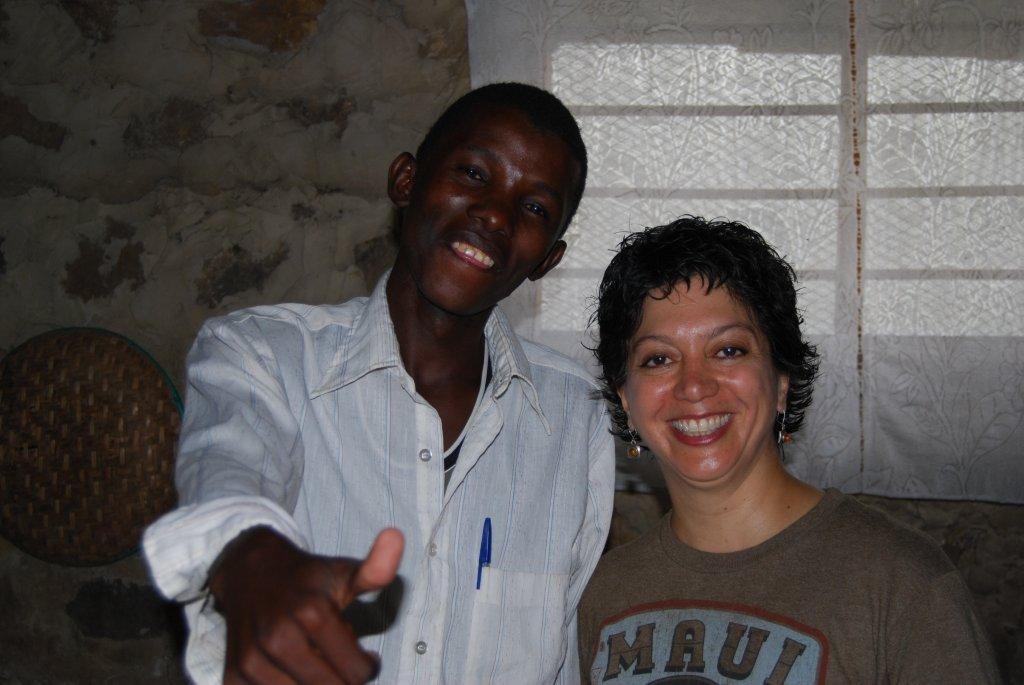
We make our way to another house – this one has enough food for the family of three who lives there. What makes me so very happy is that I meet Benson once again. He was the first child introduced to ARVs in this program and we provided them for him long ago. Now, he receives school fees through us, as well as nutritional support when needed. Benson is a character and when we take a photo, he holds his thumb up, showing the world that he is ok. The truth is, he is doing just fine. Our work works!

He dreams of being a mechanic.

I return to the office where I meet again with Sister Veronica. We are dreaming big now. They must become a self-sustaining program and we have some ideas. We put our heads together and think, plot and plan. Just wait, world…one day soon, I’ll be writing about a program which became self-sustaining through the grit and determination of a nun, an amazing team of volunteers, social workers, guardians, and children. The story hasn’t ended here, not by a long run. I am hopeful today and know that even though I can’t see the end result now, at this very minute, it will be a good one.

Sunday, June 10, 2012

How Do You Treat Children with AIDS?

Do you know how AIDS is treated in children? Do you know how effective it can be?
For adults, the primary combatant against the one-two punch of HIV and AIDS is antiretroviral therapy. These drugs delay the onset of AIDS indefinitely by pinpointing and undermining any of numerous stages in AIDS’ development. One type of antiretroviral drugs, reverse transcriptase inhibitors, disables the ability of the HIV virus to replicate its DNA, stopping its spread within the body. Another type, protease inhibitors, prevents human cells from replicating the virus. Yet another set of drugs, fusion and entry inhibitors, protects cells from penetration by the virus. The World Health Organization recommends that each HIV+ patient take a personalized mixture of these three antiretroviral drugs. Such a regimen is called highly active antiretroviral therapy (HAART).
Developed mostly during the 1990s, with small breakthroughs occurring throughout the 2000s, HAART drugs have been critical in fighting the virus. Adherence to a prescribed HAART regimen can turn a lethal disease into a manageable (though still lifelong) condition, provided the medications are diverse enough that the patient does not develop a strain of HIV that is immune to them. In the United States, because of them, thousands of people have survived well past their HIV-estimated life expectancy. These medications allow HIV victims to lead something very close to a normal life. Unfortunately, in the developing world, the medications have not been distributed nearly as widely as possible. And among those whom HAART has reached, HIV+ children are underrepresented—this is why the AFCA does the work that it does.
Because HIV+ children and especially infants succumb more quickly to AIDS than adults do, the children’s treatment regimen is more severe—and much more needed. On average, the younger the victim, the faster the disease will set in. Additionally, especially with infants, laboratories are far less able to predict how fast a child will develop AIDS than how fast an adult will. This makes the provision of treatment all the more critical. With regard to newborns, pregnant mothers are encouraged to take HAART as soon as possible in order to prevent transmission to their children. Usually, if begun quickly enough, this effort is successful. Should it fail, however, the newborn should receive medication every day for the first week of his or her life and should begin a set HAART regimen as soon as possible thereafter.
Children’s particular vulnerability to the virus makes the AFCA’s work all the more powerful. At our 16 sites across Africa, the AFCA fights to provide antiretroviral therapy for children who need it. Find out how you can get involved on the AFCA website!

Saturday, June 9, 2012

Arrival in Kenya


June 8, 2012 – CAR – Kenya

I am writing reports and catching up on my receipt record keeping this morning, while taking brief breaks to read about the history of the wars in DRC.  It is a terribly complicated history and I am not sure that I understand any more now than I did previously.  All I know for sure is that evil is everywhere in this world and that it has manifested itself if such violence in northeast Congo that it makes it hard to comprehend how people continue on with their lives once they’ve faced what they have witnessed and in many cases, endured.  It is also incomprehensible why these wars have not been covered by the media. Is the loss of 5,000,000 lives not worth mention?

As I wait for my flight from Bangui to Nairobi (where I’ll continue on to Mombasa), thoughts keep recurring in my mind and there is no end to what one could ask and to what one would receive no satisfactory answers to.  Sometimes I hear things that make me so sad, so weighed down, that it is hard to know what to say or think next.  I feel like clutching my stomach and rolling up in a ball to not feel the pain I know others feel daily. I pray because it is all I can do and it is all I know that will make a difference, as peace can only come through the One who IS PEACE. 

June 9, 2012 – Mombasa, Kenya

My flight from Nairobi to Mombasa has been delayed and I find out my bag is lost.  I am hoping the bag will arrive today because I would love to change my clothes.  These travel clothes are red with dirt and if asked, no one would say my boots are the purple I knew them to be.  A pair of sandals would be perfect right now, as would a clean shirt into which I can sweat anew. 

It is so good to be among friends! I love seeing Veronica’s face at the airport and we laugh as we compare our grey hairs which we agree are due to stress and not age. She searches through my hair as though looking for lice and I tell her we look like monkeys and need to behave.  This makes her laugh out loud, as though behaving is not something she can do.

She asks how Juju is, seeing a kindred spirit in her.  One day again, they will see each other and will recognize each other in the other’s eyes.  She asks for Malaika (angel), which is Aiden.  He was so young when he went to Kilimanjaro to wait for Eric to climb that everyone loved holding him.  He was called Malaika because he was so white.

Today’s schedule is hectic:

·         Play with kids at the clinic and attend Kid’s Day (favorite part of these trips)

·         Visit a community garden

·         Discuss garden Internship and way forward

·         Work together with Veronica (head of this program) on a grant

·         Follow up with some of the children who receive schools fees

·         Buy milk for our family’s stay in Zimbabwe

·         Check email – I hope, I hope, I hope!!

Thursday, June 7, 2012

Rest stop in Bangui


June 7, 2012 – Bangui, Central African Republic
After a great night sleep, I find myself with an easy-going day.  I needed this day in between border crossings and the flight to Kenya because I had no idea if I’d make the crossing on time.  Because I did manage to cross in time, I have an extra day, which allowed me to wash my clothes (how will I EVER get the red dirt out of my jeans?) and shop for some amoeba and parasite medicine, should I need it later on.  Thelma and I went out to a nice place for lunch because I am so grateful to her for all she’s done for me, hosting me in Bangui.  Before you knew it, I find myself floating.
I am floating, staring at the American flag between palm trees.

I am swimming in the Ambassador’s pool in a pair of boxer shorts and a t-shirt because I never thought of packing a bathing suit for this trip. Good thing it is just Thelma and me cooling off here after a very, very hot day.

Tomorrow I start the trek to Mombasa, Kenya.  What will happen then?  Can’t wait to find out!

Wednesday, June 6, 2012

Gemena Meetings and then an early start back to Bangui

June 5, 2012 – Gemena, DRC
Today starts very, very early (4:30am), thanks to a large rodent living above my room at the Elikya Center. It is so large, in fact, that I think Rachel is having trouble moving a suitcase in the next room, although the sound is coming from above, not beside me.  Either way, I go to see if I can help her and she laughs.  She is coming to see if she can help me with anything!  No, it is neither of us…it is a large rat of sorts.  No more sleep for me, thank you very much!
With hours to kill before work starts at 8am, we take cold showers, eat a simple breakfast, and walk into town.  It is an easy 35 minute walk with everyone stopping us to ask where we are going and to introduce themselves.  The sun is pretty hot already and I feel my shirt sticking to me, even though it is not yet 8am.
We meet at the Gemena office with the PEASIT team, Rachel acting as my translator. They are the folks who help children with HIV/AIDS on the social end of the spectrum.  We have a great talk and make plans for support, assuming they will do better on reporting.  They want to grow so quickly!  Too quickly, I tell them.  We talk about patience and about making this sustainable so that we all work ourselves out of jobs.  We discuss the need to plan well but to not get stuck in planning sessions while nothing gets done.  Priorities. Monitoring. Evaluation.  All these things were discussed among friends and it was a good time.
This team of lovely men and women surprise me by hosting a lunch which they planned and cooked. The food is delicious!  Mama Francois is a fabulous cook and I could eat the goat she cooks every day if I could.  After jokes, laughter, good food, and chatting, the group humors me and they sing a couple of sounds.  What a talented group they are and they know how to meld their voices as they sing together.  One man who works with the deaf signs everything being sung and I love seeing yet another language for the deaf which I’ve never seen.  It really is like music to my ears even though there is no sound.
June 6, 2012 – DRC to CAR
The alarm goes off at 2:15am and I hurry to put on my jeans and boots.  Gilbert, a mechanic named Augustine and I are heading back to CAR, hoping to make it across the border before 5pm, when it closes. 
The night is beautiful!  We careen through villages who are fast asleep.  The quiet is only broken by the loud rumblings of our G&S (Glue and Spit) pickup truck, which Gilbert has been working on for three days. 
Six hours pass.
Gilbert is falling asleep.  He helped a friend last night and didn’t get much rest before we took off and it is catching up with him.  I offer to drive and he accepts!  I think he is kidding and I really think Augustine wishes he is kidding.  But, he is not and in no time, I am behind G&S’s wheel, going up and down huge crevasses, skirting puddles, going through puddles, and basically just being Gilbert.  People stop what they are doing and point and some scream “a white woman is driving!”.  Gilbert laughs, as do I.  I have no idea what Augustine does, but I think he likes my driving because I am slower and more careful with the chickens and goats who cross our path.  This means less sudden turns and less flying around as we hit the holes.
Another hour passes and I change seats with Gilbert because we are coming on a police crossing and I really don’t want to deal with that.
We get a flat tire.
With the tire fixed, we carry on for another hour.  We pass a large broken down truck and pick up a woman and her toddler and baby, as they are going in our direction and need a ride.  I take the baby with me, as the toddler screams hysterically every time I come near.  Her mom explains to me with a laugh that the child has never seen a white person.  I laugh and make funny faces at the little girl who wails all the louder.  The baby doesn’t mind my color and she sleeps for the hour we manage to ride before something is wrong with the back axle. 
Half an hour after we stop, we are on the road again and the baby plays with a bracelet Juju made me and which I haven’t taken off.  Gilbert and I bet to see who can figure out when we’ll reach the border.  G doesn’t speak English, so the fact that we can bet is amazing.  He votes for 1:30pm.  I vote for after 3:00pm.  He looks horrified and a bit insulted that I think that he can’t make it from Gemena to Bangui in less than 12 hours.  I tell him I hope he is right.  Since Gilbert is tired, I ply him for Lingala words to keep him awake.  He asks me to describe the difference between the words “woman and wife”, “children and child”, and to let him know what “like”, “difference”, and “occasion” mean.  This keeps s busy for a while.  The baby falls back asleep.
Gilbert lets me know he is going to win the bet and that I can say “Bravo, Gilbert” in 20 minutes, when we reach the border at Zongo.  I am so happy!  I have given all my food away and all I’ve had all day is a granola bar at 6am.  Suddenly, something goes terribly wrong with the car and even I, a non-mechanic, know we are in big trouble.  It is the transmission and we are stuck.  Really stuck.  The woman and children walk on, leaving us with a wave and a smile.  G and I walk a while to find a place with a phone signal.  We walk some more.  He gets a signal. He makes a call and ½ hour later, two motorcycles appear to take us to the river crossing.  G is a man of his word…he said he take me, so he does.  Leaving Augustine to guard his truck, he kicks off one driver and tells him to ride with the other driver and my bag, while G will drive me.  It is surreal, going from the truck to the back of a bike with G. 
The four of us whip down the road and we make it to Bangui, CAR in time.  G hands me over to Thelma, who is hosting me tonight.  His last words to me are “Mission Accomplished”. 
I am sure G is now working under his truck, trying to get that transmission working. 


I win the bet.

Bangui to Tandala

Bangui, Central African Republic (CAR) – June 1, 2012
I watch a silent concert take place and it takes my breath away.  Lightning, without a sound before or after it, dances across the sky, providing us with a glimpse of the depth and width of the surrounding clouds.  Sometimes, the flashes happen vertically and sometimes, it seems the lightning dances horizontally through the layers of black, grey and apparently, white clouds that wrap around the bright.  It was awesome and I find myself unable to move as I watch the sky in central Africa.
Tandala, Democratic Republic of Congo (DRC) – June 2, 2012
Expecting some sort of rain to take away the oppressive humidity, I am disappointed, but manage to sleep well enough to feel alive.  After an amazing breakfast of yogurt, oatmeal, bananas, and apples (what a surprise that was!  I have never seen an apple in the African countries I’ve visited), I am closer to crossing the river into DRC. 
Gilbert is late.
He will help me with customs on both sides of the border and he is tied up right now - no matter that he knew I was coming over one week ago.  I wait.  It is too hot to put on my boots.  I sit at 6:45am, sweating in my jeans, t-shirt and bare feet.  I limit myself to one sip of water every 15-20 minutes, fearing that I’ll need to ask for too many stops if I fill up with liquid.
We are supposed to leave at 8am so that we can cross the river and start the eight hour journey to Tandala.  With two border crossings to take care of, we really want to leave on time.  Gilbert shows up at 10:45am.
He takes my passport, which at this point in my life is the most important possession I own.  I shadow him like a puppy during the entire process of getting out of CAR.  We go to a hut on one side of the river and out of nowhere, a chair is brought for me to sit as I wait for my passport to be returned to me.  I see money flashing around as my passport changes hands three times and as Gilbert hires two men to carry my bags to the dugout canoe in which we will cross to DRC.  As soon as the process is done, we scramble down a little hill to arrive at the canoe landing place and again, money changes hands with the man in charge of the canoes.  He refuses to take one of my bags and in the blink of an eye, Gilbert reaches out and retrieves his money.  It happens so quickly, not even the man is aware of what happened until he notices his empty hand.  Words get a little heated and I hear over and over that “she is a missionary”.  I don’t know at this time that my army duffel bag is a problem.  They think I am somehow attached to an army and they don’t want to carry me or the bag across the river.  This is a serious problem and money isn’t going to buy me a passage, not with that bag.  Minutes pass, words are tossed about and I pretend I am not there.  I focus on the river, on the people bathing on one side, covered in white soap bubbles.  On the men washing clothes, beating them against rocks and laying them on the sand to dry.  On children splashing in the water, smiling and waving when our eyes meet.
At last, a head motion indicates that the bag and I can get into the canoe.  We move across an almost still river, put-putting across an international boundary where every day live happens.
Yellow-shirted police stand on the other side barely acknowledging our presence as they balance their old Kalashnikovs in their hands.  Once again, I follow Gilbert closely as he carries my passport to another hut, but this time in Zongu, Democratic Republic of Congo (DRC).  My bags are thrown into the back of a pickup truck full of water jugs which are apparently going to Tandala with me.  I notice that the army bag is packed tightly beneath the jugs, which means the border police do not know to check or confiscate it.  Without a word to me, officials take notes from my passport.  Eyes look at me but no words are spoken.  Twenty minutes of pen scratching and casual glances later, I tuck my passport into my bag and climb into the truck.  
I cannot believe the truck in which we will be traveling actually works!  It is held together by wires and cables and screws and things of that sort. I settle into the front seat by Gilbert and prop my feet up on my backpack, with two bottles of water beside me, one bag of snacks (boiled eggs and bread) and two long baguettes on top of me.  Behind me, separated by the window and the end of the cab, on top of suitcases and water jugs, sits Zambe and Solongue.  Zambe is the deaf “mechanic” and Sonongue is simply hitching a ride.  What a ride it turns out to be! 
We bob and weave. Our entire bodies levitate as we get airborne because we don’t see a hole in time. We go through huge holes filled with water.  We drive through long tough grass when we need to pass huge trucks broken down by too many craters. 
Gilbert and I manage to practice my Lingala and I teach him some English words before we break down for the first time.  Zambe and Gilbert speak with their hands in a language that is their own.  I get out of the truck to take some photos and Zambe removes the cover of my seat, where he reaches to find some cables tied together with a plastic bag.  Apparently, we have a short circuit and the bags are not doing their job well enough, so he grabs some handy electric tape and in no time, has the cable securely taped up.  This process is repeated three times at different parts of the cable.  The cables are crammed back down into the seat and the battery is jumped.  The battery is behind my chair because they don’t want it stolen at night. 
We rattle on for a while and I notice that with quite some frequency, the rattle becomes a loud thunk, thunk, thunk.  When Gilbert notices the sound, he quickly turns the wheel to the right and the sound stops.  Sometimes, he gets engrossed in his thoughts and I, in my mind, say “turn the wheel, turn the wheel”.  When he does, we are left with only the regular rattle of a car held together with spit and glue.
The second time we break down, it is simply a matter of adding water to the truck.  I decide to take a potty break so I step into the tall grass that edges the road.  It is thick and hard on my arms, but I push through.  Two steps in and I can’t see the road at all.  Making sure no one sees me, I take four steps. When I emerge, I almost get bowled over by a cyclist who is so surprised to see a white person coming out of the grass, he almost falls.
We start our journey again.
A new noise is heard above the rattling and the thunk, thunk, thunk.  It is the sound of something dragging and then, there is no more new sound.  We stop to see what happened and hear a far-away shout.  Through my camera lens, I see a man running towards us, carrying a large curved piece of metal.  Gilbert meets him half way and accepts the piece of the car which has fallen.  He can’t be bothered to reattach it because we are behind schedule, so he crams it in between the water jugs.  While he pays the man for his trouble, Zambe is happily and lustily whacking the bottom of the truck with a heavy hammer.  What he is trying to accomplish is impossible to determine, but after five or six minutes of intense pounding, he emerges with a large smile and pronounces us ready to resume the trip.
The sky turns dark in front of us and I learn the words for rain (bula), lightning (kake) and thunder (ebeti). I worry about Solonge, Zambe and the bags in the back of the truck, as there is no covering. I pray for the air to cool down but for the rain to be kept at bay.  I should have been praying for the car because at that moment, we get our first flat tire.  Because I have a flashlight, I am able to assist Gilbert while Zambe takes care of other parts of the car that need attention.  We are on our way soon enough, but the sky is dark. 
The rain is holding off. 
They air is not as muggy.
I crack a hard-boiled egg and peel it outside the window.  We hit a large puddle and my hand and egg are covered in mud.  I imagine my egg turned red because my hand was red when I wash it hours later. I consider the consequences and decide that since it rained recently, since no humans bathe in the mud, and since I am hungry, the egg is edible.  I allow it to dry, brush off the mud and two of us share an egg. 
The villages we pass are now shadows broken by tiny fires built inside the round huts.  I hear children and adults singing at a distance and soon, then, the sound of a guitar. Village to village, music is sung and the evening is magical. I am glad we are breaking down because I am seeing Congo as it is in the dark.  The simple pleasure of singing together – 30-40 voices at a time – is shared by many here and I am enchanted.  I want the evening to continue, for the peace I feel to not end.  I want my family to enjoy this time with me and I keep them in mind as each village passes by us as we make our way.
After leaning animal names, I am now learning the words for big (monene) and small (moke).
I hear a strange sound, like the sound of a lot of air rushing out of something. I practice my lingala and ask Gilbert if the problem this time is monene.  He smiles and says “yes, it is, monene – it is big”.  He keeps driving, trying to find a village where we can stop.  When we arrive, I get out of the truck once more, but he insists that I stay put and eat some dinner.  He scrounges in the back of the truck and produces a pan of fish, giving it to me with instructions to eat well.  It is dark and I can’t see what I am eating, but it is delicious.  We all eat as some village magician sets to work on our tire.  Since we have no working replacement, they somehow conjure a way to fix the least damaged tire.  Tomorrow, in the light, I will see if duct tape is part of the solution.  Between the village man, our deaf mechanic and Gilbert, they communicate in the dark and the fixed tire is put in place.  We share our fish and bread.  At 11:34pm I recognize the next village and feel at home.  I make out Tandala Hospital in the dark.
 All is well.
June 3, 2012 – Tandala Hospital
Today is a lazy day and I sleep until 7:30 because I am tired.  Of course, there is company waiting to say hello before I ever open my eyes and I feel lazy when I finally appear.  After a breakfast of coffee and cookies, Rachel and I ponder if we want to attend an ordination celebration, which I know will take at least four hours and will be totally in Lingala.  While I am not crazy about the idea, I am willing to go.  At the last minute, a government person shows up, asking for my passport.  He states I must pay some money, now that I am in Tandala.  I have paid for a visa. I have paid two villages back.  I am forced to pay again.  The decision is made for us that we are to stay at the guesthouse because it is too late to go to church.
I read.
I nap.
I catch up on my water drinking.
I hold a meeting with doctors and PEASIT (social workers who work with HIV+ children) to determine the division of labor, how best to communicate with everyone here and to determine tomorrow and Tuesday’s activities. 
Walk away not knowing if the meeting is successful.
June 4, 2012 – Tandala Hospital, Tandala Health Zone and road to Gemena
The morning starts at 4:00am with a thunder and lightning storm like no other.  It is gorgeous and the sight beyond my window is a blur.  The pounding of the rain on the roof is deafening and the hot earth gives up its steam as it inhales the wet.  I lay in bed listening and feeling the rain as the wind shifts and bit of it comes through the net that keeps mosquitos out in the open and away from me.  These droplets startle me from time to time, but feel good.  I wonder how this storm will affect our travels to Gemena later on as I time seconds between thunder and lightning.
Rachel and I make our way to Dentist Bofio’s home, as he’s invited us to breakfast.  He announces that he has tuna to celebrate my arrival and with a flourish, produces a packet of tuna a friend of his left behind many days ago.  Rachel produces McDonald’s packets of mayonnaise from her purse and I prepare the tuna salad for a breakfast sandwich.  This, with tea, officially starts our day.
I meet with doctors and discuss plans. Dreams.  Thoughts. Ideas. At noon I am ready to leave. My stomach lets me know I must eat soon.  By 1:00pm, I am not concentrating well on a story told by someone, but try to focus.  Soon enough, Frank walks me to the guesthouse where I whip up a strange lunch of macaroni and cheese, a white garlic/tuna sauce, leftover rice with beans and eggs, and pineapple.  People always drop by for lunch, breakfast, dinner.  We share this wild lunch and laugh.
I sit behind Bamusa on a motorcycle and we follow Deolo and Filo to community gardens boasting beautiful corn.  The wind whips us as we ride and people stare at the white woman on the back of the bike.  They smile and wave and I wave back.  It is funny to see them take a second glance once they realize the second rider is not black. 
Children come out of the woodwork when my camera makes its appearance and soon, the space in front of a hut is crowded.  I am surrounded by smiling, touching children.  I take photos and show them.  They squeal with laughter and mamas come out to see what the commotion is about.  Without a word, the mamas step into a hut and return with a sleeping baby and they, too, want a photo.  I look at these moms and see myself – I want my children to be remembered.  I like a swept home. I want my children to be fed, to be happy, to be alive. 
The gardens are gorgeous and I am so happy we visited.  I want to do more.
Walking from a garden to the motorcycles, we hear that Rachel is on her way in a truck, ready to pick me up and take me to Gemena.  We meet her part way and I scrunch into the front seat with Gilbert and Rachel.  We laugh and laugh the four hours from Tandala to Gemena.  Last year, it took one and a half hours.  This year four hours.  The rains have destroyed the road and it is hard to go anywhere fast.  I try to imagine how trucks will bring the labor beds to Tandala, but I leave that to God because the problem is that big.
Rachel tells Gilbert “whenever Tanya is around, I laugh the most”. This makes me happy. 
One thing I know: if we can’t laugh while in the middle of terrible poverty, absolute hopelessness, and hunger, we will cry.  We find reasons to laugh and we hold on to them, making the kilometers pass more quickly. 
The moon is high and perfectly round.  I ask questions. Rachel translates and Gilbert answers.  I learn so much tonight. 
June 5, 2012 – Gemena and Elykia Center


My grandmother turns 95 today.  Happy day to a woman I admire immensely, who has taught me through her life and faith.  When you meet your Maker face to face one day, my Yeya, He will be so proud of you and will say “well done, well done”.

Saturday, June 2, 2012

Four Days into Tanya's Journey


Harrisburg, PA – left home at 2:30pm – May 30th, 2012

London, England – May 31, 2012 (1:27pm EST, 6:27pm here)

There’s a certain excitement that starts in my belly and moves up to my neck and finally to my face, where I feel a stupidly large smile forming.  While I’ve known I am returning to Africa for quite a long time now, it is only when I actually hand over my passport to be stamped and am welcomed to a new country that I know I truly am returning.  Right now, I am sitting in Heathrow airport in London, recalling the many flights I’ve taken through this city both as a single person and later, married, travelling with Eric and the kids. 

Costa CafĂ© is still here – my meeting place with other International Volunteers for Habitat for Humanity, with whom I worked in Eastern Europe, Russia, Kyrgyzstan, and Portugal a few years back.  I feel the same excitement I felt then…my waiting grounds where I’ll board a plane which will take me to a place where the foods, smells and air are different.  I can’t wait to return to Congo, Kenya and Zimbabwe...I have friends there I want to see again, favorite lodgings I’ve missed and children who I want to see – have they grown? Are they doing well in school?  What has changed for them in the past year? What do we need to do to help them get through the next one with hope, health and dignity?

My eyes are a bit bleary from lack of decent sleep and they sting a little.  I hope this means that I will sleep deeply during the next flight.  Two flights down, two to go (and a long drive) until I reach my first intended destination, Tandala Hospital.  There, I will unload a large army duffel bag chock full of sutures (I wonder what customs thought when they x-rayed that bag?), gloves, water filters, and other needed supplies.  Can’t wait – seeing the doctors when they receive these items is like seeing Christmas through the eyes of a three-year old. 

I love it.

Nairobi, Kenya sitting in a plane to Bangui – June 31, 2012

My dream of sleeping in the plane ride from Kenya to CAR has fallen to the wayside, as I was seated by a 2-year old whose mother didn’t believe in paying attention to.  With no toys, books, or someone to talk to, the little guy thought it would be fun to poke me and shake me when he even got the hint of sleep coming over me.  If I ignore him, he kicks. 

The mom looks tired and it seems she’s using this plane ride as a personal vacation – one where she is continuously putting on new makeup and where she is straightening her crown.  Yes, I kid you not…she is wearing a crown.  The gold-colored and pearl crown is in stark contrast to the incredibly tight leopard pants and tiger print shirt she is wearing.  Maybe she thinks she is the queen of Africa? Don’t know, but what I do know is that this cute little prince here is going to start to annoy me pretty soon.  Wonder if I can offer him a Benadryl?

Bangui, Central African Republic – June 1, 2012

It is 4:53pm in Bangui and I’ve been here since 1pm.  It was a long trek to get here!  I left Harrisburg right on time, which allowed me to make my 45 minute connection in Chicago.  From there, off to London where I had a 12 hour layover.  Then, to Nairobi, with a 45 minute connection to Bangui.  I had no idea that I’d have to stop in Cameroon on my way to CAR, though!  That was a bit of a shocker.  But, I finally made it to CAR and was met by Thelma once I got through customs.  She is lovely and has graciously opened her home to me.   Her home is simple, but clean and secure.  It is in a compound which includes schools for children as well as pastoral school for French-speaking nationals from over Africa.  I feel comfortable here, even as I swelter.

It seems that I didn’t bring my capris with me, so tomorrow will be another day of wearing jeans that really have no business being worn again.  But, Thelma warned me that pants will be better than a skirt tomorrow as I have a 12 hour drive in a pick-up truck and I will be appreciative of the pants if and when we get stuck in a hole on our trip down to Tandala Hospital.  So, I’ll bathe tonight and air out my jeans and they will be on me again tomorrow.  I am so grateful for the clean t-shirts, socks and underwear I have along and for the fact that I will be able to bathe.  That is always a nice thing after two days of travel.  I know I need a bath in a bad way.

Tomorrow will start with a short drive to “the beach” – some place close to a river, where I’ll have to do customs into Congo (DRC).  A man named Gilbert will walk me through the process and I am told he will not take any lip from anyone, so I am hopeful that my duffel bag of medical supplies will make it through without a hitch.  I have granola bars ready, just in case a guard needs a snack, though.  I have found over and over again that a little kindness followed by some food (m&m’s, granola bars, beef jerky, etc) goes a long way.  So, I am ready! 

Oh, wow!  A class is about to start at the seminary and they are starting to sing.  It is amazing!  Just mind-blowingly beautiful singing is coming through the open door (too darn hot to close anything) and windows.