Sunday, June 17, 2012

Matopos National Park

June 16, 2012 - Matopos, Zimbabwe

Today is sunny and we are planning on having a fabulous day at the Matopos National Park.  With John driving the big LandRover, the rest of us pile into the back of the truck and take off with a picnic lunch packed.  We are dressed warmly because there are no windows on the truck and while it is sunny, the breeze is still chilly at this time of the morning.  About an hour into the drive, we stop to allow Aiden, Eric and AJ to sit in the top of truck.  Aiden is so excited!! His eyes are shining like little olives and he has the biggest smile on his face.  He is loving this time of freedom from car seats and let us know that he doesn’t want to use car seats ever again.

After a bit, we change positions and Juju, Morgan and I sit on the top and we feel the wind whipping through our hair as we dodge branches that threaten to knock us off the top.  We laugh and enjoy the bumps in the road, hanging on to the grill around the top of the truck, which keeps us safe.
We arrive at a gorgeous location, named a World Heritage Site three times over: topography, culture, and something else having to do with the animals there.  There are eagles of all sorts there…a veritable United Nations of eagles. Monkeys and baboons about and they visit us during our lunch time.  We join a group of other Zimbabwean families and soon, the kids are all playing together, climbing huge boulders and rocks, trees and anything that they can get on.  They chase each other and have an absolutely blast.  Morgan, Aiden and I try our hand at canoeing and we laugh uproariously as we get stuck in huge weeds and as Momo gets soaked trying to paddle.  She tells me this might be the first time she’s canoed and we are excited that it has happened here in Zimbabwe.

After a communal lunch of boersworst (beef sausage), peanut butter and jelly sandwiches (our contribution), salad, all sorts of cookies, tea, and water, AJ and Juju race Momo, Aiden and I in the canoes.  My team loses but we have the most fun, I think.  Eric is having a great time hiking with some men and he comes back full of information about what is happening in the area and with the folks we are meeting. 

We soak in the sun on lawn chairs, chat with new friends, munch on snacks, and watch the monkeys play on the rocks while our children (resembling monkeys now that they are muddy and dusty and dirty) chase them and scamper around.

June 17, 2012 – Bulawayo, Zimbabwe

Church this morning was really nice, where we met up with folks we met yesterday and met some new people, too.  When we were about to leave church, I looked around for Aiden and not finding him, started looking around.  Momo found him sipping hot tea with a bunch of people, sitting in the middle of all of them and having the time of his life.  I am so grateful that these kids are so ready to try new things, to make new friends, and to have fun.  Momo has been great, too, helping out at a youth group meeting on Friday night with AJ and making friends all around.  These three are really doing a great job at assimilating and making the best of everything. 

One of the things we are getting used to is the power cuts. Wednesday is the only day we’ll usually have electricity all day long.  Otherwise, we won’t have it on Monday morning, but will in the afternoon. We won’t have any on Tuesday. We won’t have any on Thursday morning, but will in the afternoon.  Then, Friday morning we will, but none on Friday afternoon until Saturday afternoon.  Sunday morning, we don’t have and we will on Sunday afternoon.  And, no electricity means no water.  So, we have to plan our baths and flushing of the toilet carefully. We are getting into a rhythm bit by bit.

This afternoon, we will be going to the animal orphanage to check out lions at feeding time and to have monkeys walk on us.  I think the kids will love it!

Friday, June 15, 2012

Goats and Sadza

June 14, 2012 – Bulawayo, Zimbabwe

After a breakfast of rice and a fried egg, Jodi, Morgan, Juju and I head out to distribute fifty-six goats to beneficiaries approximately three hours away.  Q takes us in a pick-up truck and what starts out as a ride on an asphalt road ends up on a narrow dirt road with small villages suddenly appearing on the side of the road.
Q tells us that we should be able to spot a giraffe and that keeps us looking out the windows.  While no giraffe materializes, we do see a group of baboons on the side of road and we go wild with excitement, taking photos of the monkeys.  We also spot impalas, which makes us happy, too.  We never do see the giraffe, but we have a fun time looking anyway.
Jodi getting ready to tag ears
Three hours later, when we reach the delivery place, we are greeted by nineteen grandmothers and grandfathers who are raising orphaned children.  We are welcomed with great smiles and a song, which is always such a welcoming sound and one with I treasure for months and years afterwards.  The goats are brought in by the chief of the village and everyone’s smiles grow even larger, if that is possible.  The para-vet vaccinates the goats.  I am given the task of marking ear tags with family names and “AFCA”, Jodi is given the task of tagging ears, Morgan and Juju take photos and video the whole process.  We are busy for quite a while and it is exciting to see how happy everyone is.  When we name one goat “Darryl”, the owner keeps repeating “I am so happy, I am soooo happy!”  She is thrilled to take three goats home with her, knowing that the orphaned children she cares for will be able to become self-sufficient if they stick to the program. 
Morgan getting a hug
When all the goats are vaccinated, tagged and distributed, a song starts.  A bit of clapping joins in and finally, foot stomping as the song changes from Shona to English and we clearly hear words in the song – “thank you very much”.  It is so sweet, this thanking for a simple gesture.  They are indeed grateful for the animals and they show it in their smiles, their hugs, their music. 
Some goats are tied together with twine. Some with plastic. Some with rope. Six are put on the back of a cart and are taken away by a team of four cute donkeys.  Everyone is in a celebratory mood and we are invited to join them for lunch.  Q is unsure how we’ll react to this, which is just silly, since I’ll try just about anything.  I sit in the round kitchen hut with the chief, the pastor, Q and the para-vet who’s been trained through this project.   A huge plate of sadza 'n chicken is placed in front of me and I eat with my right hand, making a ball with the sadsza (corn meal cooked with water) with my fingers and thumb and dipping it into the sauce to grab a piece of chicken with it. I pop it in my mouth and find it delicious.  Because people only eat once a day, they are hungry and they are happy to eat the big portion of sadsza.  I, on the other hand, am trying to figure out how I am going to eat it all.  Q notices that I cannot possibly eat it and kindly, lets me know I don’t have to finish it up.  I do my best and when I am quite done, a plate of melon, maize and squash soup is placed in front of me.  Yikes!  There is no way I can make this happen, so I ask for a small portion and eat that. 

Gertrude, Juju and a goat named Juju
This time around, I tell Morgan and Juju that they can eat the sandwiches we brought, giving them time to get more accustomed to the food and way of eating.  I want their bellies to be ready.  Because the soup was boiled hard, for a long time, I thought it was ok for them to taste it and they both did. Now, they are so curious to try other foods and that makes me happy.  Little by little, though…don’t want their bellies rebelling.

Lunch is done and I wash my hand in a bowl of water.  We say our goodbyes and hear the beginnings of a song.  It is so beautiful, it brings tears to my eyes and I notice that I am not the only one affected.  Morgan and Jodi are all emotional, too, and I think to myself, “welcome to Africa”. 

Thursday, June 14, 2012

Success in the International Antiretroviral Therapy Market!

One of the coolest success stories in the 25-year history of HIV/AIDS is the dramatic price drop of baseline antiretroviral drugs (ARV therapy, or ART) since the turn of the 21st century. These drugs are pivotal in the fight against AIDS, granting a healthy and productive life to HIV patients who adhere faithfully to a strict therapy regimen. And these drugs’ new affordability on the international market has allowed a 16-fold increase in the number of poor-country citizens receiving ARV drugs from 2003 to 2010 alone. At the end of 2010, 6.6 million people in the developing world were benefiting from them. 47% of the world’s citizens had access to ART; by now, that proportion is over half.
Here’s how the price decrease happened. In a nutshell, a combination of activism and generic drug production loosened the patent-protected monopolies surrounding the first kinds of antiretroviral medication ever developed, thereby breaking down the control that pharmaceutical companies had over their sale. In 1994, the World Trade Organization’s Agreement on Trade-Related Aspects of Property Rights (TRIPS) prohibited the production or sale of antiretroviral drugs except by the large pharmaceutical companies that developed them. This meant that treatment for AIDS, priced at $10,000-15,000, was prohibitively expensive in developing countries. Fewer than 2% of the HIV+ population in these countries acquired ART. In 2000, despite these regulations, Brazil began producing generic versions of the protected drugs, selling them at a fifth of the brand price. The same year, an Indian company, Cipla, followed suit, pricing their drugs at a mere $350 per person per year by early 2001. The competition from the generic producers angered the pharmaceutical companies but forcefully drove down the price of brand-name ARV to match Cipla’s price. Throughout the early 2000s, the downward price trend continued—now, basic, first-line ARV is available for $160-200 per person per year, and to this day, India supplies 80% of donor-funded ARV. Generic drugs are very much responsible for the expansion of treatment access around the developing world, especially in sub-Saharan Africa, where the AFCA works.
The entrance of generic drugs into the ARV market coincided with a lot of advocacy work, putting political pressure on pharmaceutical companies to loosen their hold on their monopolies. For example, the Clinton Foundation formed after President Clinton exited office, and it has lobbied for the availability of generic AIDS drugs ever since. Furthermore, in 2001, the international community reacted indignantly when 39 major pharmaceutical companies attempted to sue the South African government for passing a law that would facilitate the production and importation of generic ARVs. After several global petitions were drawn up against them, these companies were forced to back down. Though activists’ efforts have never formally changed TRIPS’ patent protection rules, they did produce a 2001 WTO resolution called the Doha Round Agreement, which declared that TRIPS would be interpreted with the intended goal of global expanding treatment access. The pharmaceutical companies have been semi-compliant; in 2006, UNITAID, an organization which funds ARV distribution and lobbies for further price reductions, began operations with moderate success. These steps represent progress and provide hope that one day ARV’s may be available to all who need them.
Today’s legal and economic picture of ARV access is still far from ideal. Much more activism is needed to dissolve the monopolies on the more effective second-line ARV medication. More information on the challenges of expanding access to come in the next few days! A more detailed account of the story of the ARV market is available at http://www.avert.org/generic.htm. In the meantime, find out how you can get directly involved and make a concrete difference by exploring our website!

Wednesday, June 13, 2012

Ahnu Boots Are a Girl's Best Friend

I want to thank our friends at Ahnu for providing me with the absolute best boots ever.  I have worn them to the top of Kilimanjaro, through the streets of Harrisburg, PA and everywhere in between. Here they are, in the Democratic Republic of Congo, looking dirtier than usual.  I am resting my feet on the truck window, as we wait for help on our 11th breakdown of the trip.

Ahnu has been a generous supporter of our work, giving us certificates for Kilimanjaro climbers and winners in our recent 5k.  I believe we host the 5k with the absolute best prizes, thanks to sposnors like Ahnu!

I've also uploaded some photos of them on a road in Congo (yes, I am the height of fashion, wearing them with a skirt), in Kenya (with baby Juma and little Rama).  Right now, they are with me in Zimbabwe, after being worn in Bangui, Central African Republic and in Johannesburg, South Africa.  They are definitely looking like they need a good cleaning right now, but they are still as comfortable as always!

We Made It!

June 12, 2012 – Johannesburg, South Africa – Bulawayo, Zimbabwe

I spy them from the top of the tall escalator.  I am on the third floor and they are in a terminal on the ground floor.  I see her first, tall and elegant, fifteen years old, my niece Morgan.  She is laughing at something one of the small ones said or did.  I scan a bit and see Juju and Aiden playing in front of her, acting funny to see her laugh again.  Eric is on the right of them, Jodi on the left of her.  My heart beat picks up and I feel it change pace.  I start walking down the escalator to get there faster and the youngest, A, looks up and stares for the span of one second or less.  I see him trying to figure it out…is this who he feels it is, in this strange airport far from home.  Suddenly, whether it is his eyes or his heart that make the decision, he leaves what he is doing and screams “mommy” over and over again as he runs towards me.  J joins in and passengers in ten terminals turn to look.  It is sweet – we are together again.  My small family that has grown to six with M and Jodi joining the group.

We fly away to our summer place in Bulawayo.

The visa process takes a long time so I take care of customs while M plays with the kids and E and Jodi take care of visas.  I chat with customs officials I’ve known in the past, those who’ve seen me through the process before and who’ve harassed me years ago, but who defended me from then on.  Not a single bag is looked at and we get through easily, with water filters and powdered milk intact.

Ncube (pronounced “click” +beh”) picks us up and brings us to our home, a cottage that the three little bears would be proud of.  One bedroom (E&T), living room/kitchen (Jodi in LR), bathroom (with flushing toilet and bathtub when water is available), and a loft (three kids) is the sum of it.  This cottage belongs to Helene and John Stambolie, our gracious hosts, and their four children.

There is no electricity on Tuesdays and therefore, no water, as the water is pumped from a borehole.  AJ, the eldest and only son of the big house, takes E to the grocery store from where we receive a bag of rice, a bag of beans, milk, eggs, bread and butter.  I start soaking the beans for tomorrow and we set about the business of settling in before it gets too dark.  M makes chocolate milk with some Milo I brought from Kenya and the kids drink that while I make some grilled cheese sandwiches with cheese given to us by the Stambolies.  With full bellies, J arranges games we brought, M unpacks loads of crafts for the summer, Jodi arranges her corner, and I organize the kitchen and our things.  A is busy checking out the yard and asks anyone who will listen if we’ll hop with him.  E is back at the market, scoping out lanterns, a fridge the Stambolies ordered (just don’t open it much on days with no electricity), and anything else we might need.

We are invited to go to the big house for a proper dinner, but A refuses to go.  He says he is too tired and just wants sleep.  This from the child that didn’t stop hopping around outside while we set things up and who has already fallen in love with the large yard in which he is free to play as long as he pleases.  I bathe him out of a bucket of water we pilfer.  The second half of the bucket is enough to bathe J.  Snuggled in clean, warm pajamas, A is asleep in thirty seconds, not caring that the bed, pillow, house, surroundings are new.  The rest of us take five steps and find ourselves in the big house where a dinner of spaghetti and salad await us.  With easy conversation and a dinner followed by tea, I know, I just know, that this is going to be a good summer.  M feels it too, my beautiful niece.

Monday, June 11, 2012

Mombasa Days

June 10, 2012

Tonight I celebrate seven years of working with this particular program. So does Sister Veronica and Lucy. We three have been together through some hairy times and they determined that we’ll work another twenty years together. I complain that I will have no hair left by that time, the stress is too much, the fundraising so hard. With incredulous eyes, Vero says to me “don’t give up on faith, Tanya. You must keep the faith that has brought you here today – you hear me? We will do what we can together because it is not our work that we do, but God’s.”

I guess that is that, isn’t it?

June 11, 2012 –Mombasa, Kenya

I wake up to the sound of the call to worship from the mosque next door. It is quite loud at this time of the morning and I am irritated because I am tired and don’t want to wake up quite yet. Now that I am awake, though, I start to focus on the fact that I am sweating inside my mosquito net. I don’t dare take it off because I already am looking like corn on the cob and don’t want any more bites. I resort to tossing and turning and praying for daylight to appear quickly.

Soon, I am in the field with Lucy, visiting children and am hurting again. We visit a family with six children and a mom, who is not feeling well at all. They haven’t eaten since yesterday morning and they look wan and tired. I can’t stand it and make my way to the car and search through my bag for any food I have left. I find some boiled eggs which were meant to be my breakfast, as well as some protein shake a dear friend gave me before I left home. I am sure she won’t mind knowing that the shake is now in the hands of the mom, with instructions that she give it to Rama, the boy in our program, so he can drink it when he takes his medicine. I dig around some more and find a large can of powdered milk I had purchased for my family while we are in Zimbabwe. We find a tiny store, no more than a hut, and purchase maize, rice, beans, tomato paste, oil, and salt. We walk some more and find a woman selling one cabbage (we snag it), twelve bananas (we buy them), five onions (we add them to our stack), and one mango (we purchase it). With all this, we trot back to the hovel where the family lives and deposit our purchases. The little ones try to light up when they see the fruit but were too weak to do much about it. We peel eggs and banana and I see them feeling better. It is miraculous. In seconds, they are better. Amazing what a little food and hope can do.

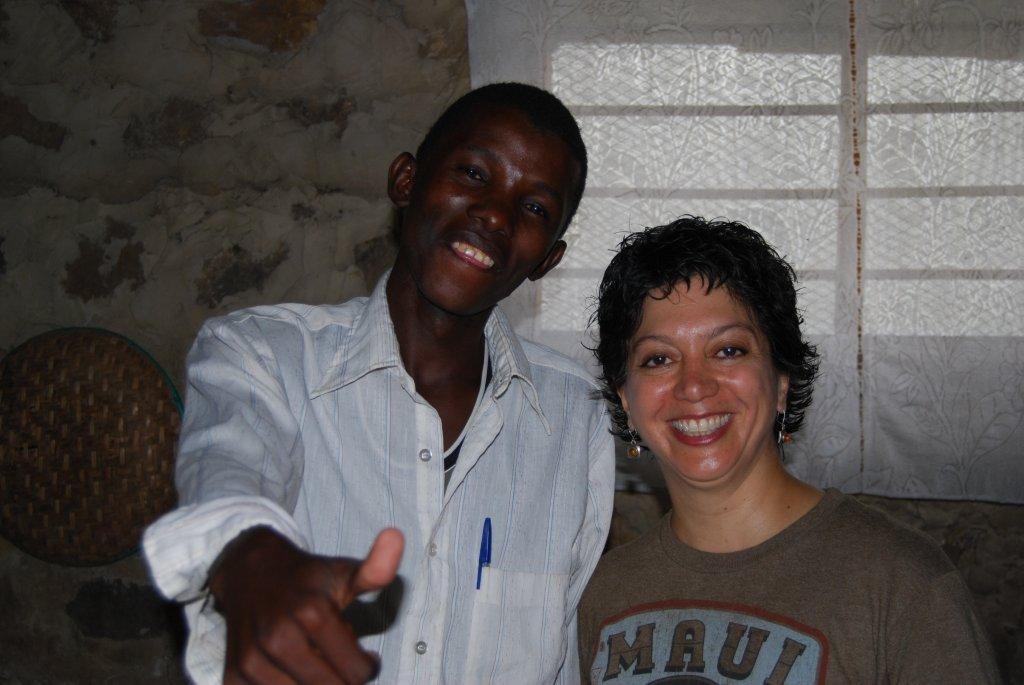
We make our way to another house – this one has enough food for the family of three who lives there. What makes me so very happy is that I meet Benson once again. He was the first child introduced to ARVs in this program and we provided them for him long ago. Now, he receives school fees through us, as well as nutritional support when needed. Benson is a character and when we take a photo, he holds his thumb up, showing the world that he is ok. The truth is, he is doing just fine. Our work works!

He dreams of being a mechanic.

I return to the office where I meet again with Sister Veronica. We are dreaming big now. They must become a self-sustaining program and we have some ideas. We put our heads together and think, plot and plan. Just wait, world…one day soon, I’ll be writing about a program which became self-sustaining through the grit and determination of a nun, an amazing team of volunteers, social workers, guardians, and children. The story hasn’t ended here, not by a long run. I am hopeful today and know that even though I can’t see the end result now, at this very minute, it will be a good one.

Sunday, June 10, 2012

How Do You Treat Children with AIDS?

Do you know how AIDS is treated in children? Do you know how effective it can be?
For adults, the primary combatant against the one-two punch of HIV and AIDS is antiretroviral therapy. These drugs delay the onset of AIDS indefinitely by pinpointing and undermining any of numerous stages in AIDS’ development. One type of antiretroviral drugs, reverse transcriptase inhibitors, disables the ability of the HIV virus to replicate its DNA, stopping its spread within the body. Another type, protease inhibitors, prevents human cells from replicating the virus. Yet another set of drugs, fusion and entry inhibitors, protects cells from penetration by the virus. The World Health Organization recommends that each HIV+ patient take a personalized mixture of these three antiretroviral drugs. Such a regimen is called highly active antiretroviral therapy (HAART).
Developed mostly during the 1990s, with small breakthroughs occurring throughout the 2000s, HAART drugs have been critical in fighting the virus. Adherence to a prescribed HAART regimen can turn a lethal disease into a manageable (though still lifelong) condition, provided the medications are diverse enough that the patient does not develop a strain of HIV that is immune to them. In the United States, because of them, thousands of people have survived well past their HIV-estimated life expectancy. These medications allow HIV victims to lead something very close to a normal life. Unfortunately, in the developing world, the medications have not been distributed nearly as widely as possible. And among those whom HAART has reached, HIV+ children are underrepresented—this is why the AFCA does the work that it does.
Because HIV+ children and especially infants succumb more quickly to AIDS than adults do, the children’s treatment regimen is more severe—and much more needed. On average, the younger the victim, the faster the disease will set in. Additionally, especially with infants, laboratories are far less able to predict how fast a child will develop AIDS than how fast an adult will. This makes the provision of treatment all the more critical. With regard to newborns, pregnant mothers are encouraged to take HAART as soon as possible in order to prevent transmission to their children. Usually, if begun quickly enough, this effort is successful. Should it fail, however, the newborn should receive medication every day for the first week of his or her life and should begin a set HAART regimen as soon as possible thereafter.
Children’s particular vulnerability to the virus makes the AFCA’s work all the more powerful. At our 16 sites across Africa, the AFCA fights to provide antiretroviral therapy for children who need it. Find out how you can get involved on the AFCA website!